Desk size guide: measure the wall, then the chair
Buy the desk that fits the room you have, not the room in the product photo. In a studio, a one-bed apartment, or a bedroom office — especially under about 538 ft² (≈ 50 m²) — width is only the opening number. Depth, chair rollback, and a radiator under the window decide whether you can work.
Use this before you pick a folding wall desk, a compact corner, or a small sit-stand frame. Shape and lease limits: folding vs corner vs sit-stand for renters.
Measure these five things first
Wall width
Measure the clear run: door casing or wardrobe to window reveal or corner. Skip the door opening and any wall behind a radiator you will not block. If a bed, sofa, or nightstand already eats 11.8–15.7 in (30–40 cm), subtract it. In small homes the leftover often lands in the 31.5–47.2 in (80–120 cm) band — enough for a laptop and often one monitor, rarely for dual screens.
Usable depth (radiator, baseboard, door swing, window sill)
Stand where the desk front will be, after these objects:
- Baseboard often adds 0.4–0.8 in (1–2 cm). Most backs clear it; some folding brackets do not sit flush.
- Radiators often project 3.9–5.9 in (10–15 cm). Many leases want them unblocked.
- Window sills steal a few centimeters and dump glare on the screen.
- Door swing: a typical interior door is about 27.6–31.5 in (70–80 cm) wide. If the open arc crosses the desk zone, that width is not yours.
Chair rollback
Sit in the chair you will use. Roll back until you can stand without kicking the bed, sofa, or wall. For a rolling task chair, plan about 35–43 in (90–110 cm) from the front edge of the desk to the first thing behind you. An armless stool against a wall you never walk behind can live with less — often 23.6–29.5 in (60–75 cm).
Desk height vs the chair you already own
Typical sitting desks land around 28–30 in (72–76 cm) to the top — a common range, not a rule. Match seat height and knee clearance. Compact sit-stand frames still need the same floor footprint — folding vs corner vs sit-stand. This is layout matching, not a health standard.
Monitor distance
A typical viewing distance for a 24–27 in monitor is on the order of 19.7–29.5 in (50–75 cm) from eyes to glass. On a shallow desk, that distance comes from sitting back. A clamp monitor arm can lift the screen off the top if the desktop is thick enough — monitor arms on a narrow desk.
Conversion honesty (inches first)
We lead with inches and keep centimeters in parentheses. Use ≈, not fake precision.
| inches | ≈ cm |
|---|---|
| 31.5 | 80 |
| 35.4 | 90 |
| 39.4 | 100 |
| 47.2 | 120 |
| 55.1 | 140 |
| 15.7 (depth) | 40 |
| 19.7 (depth) | 50 |
| 23.6 (depth) | 60 |
| 28–30 (sitting height) | 72–76 |
A 94 in wall is ≈ 2.4 m. A 538 ft² home is ≈ 50 m².
Decision tables
Minimum desk width by the work you actually do
| Work on the desk | Typical minimum width | Notes |
|---|---|---|
| Laptop only | 31.5 in (80 cm) | Fine on a folding wall desk. |
| Laptop + paper notebook | 35.4–39.4 in (90–100 cm) | 80 cm gets cramped once you take notes. |
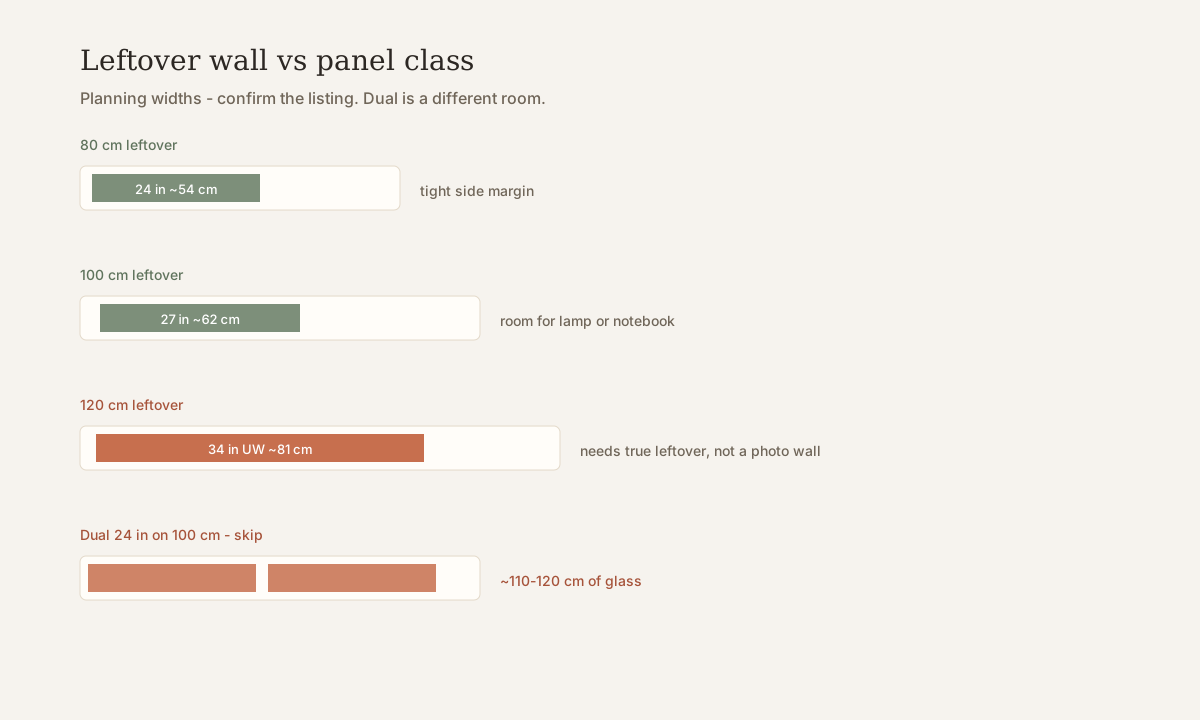
| One 24–27 in monitor + keyboard | 39.4–47.2 in (100–120 cm) | 24 in panel often ~21.3 in (54 cm) wide; 27 in often ~24 in (61 cm) before the stand. |
| Ultrawide or dual monitors | 55.1 in (140 cm) and up | Dual 24 in glass is already ~43.3 in (110 cm). On an 80–120 cm wall, dual is usually a bad idea. |
If the leftover wall is 39.4 in (100 cm), plan for one display.
Depth vs keyboard and monitor
| Desk depth | What it feels like | When to use it |
|---|---|---|
| 15.7 in (40 cm) | Tight. Keyboard and monitor compete. | Laptop-only or folding wall desks — not a 27 in screen on a stand. |
| 19.7 in (50 cm) | The common renter compromise. | Studio and bedroom offices with tight chair space. |
| 23.6 in (60 cm) | Comfortable — if chair rollback still fits. | Living-room walls with a walk lane. |
40 cm is tight; 50 cm is the common renter compromise; 60 cm is comfortable if the chair still has room.
Chair clearance
Measure from the front edge of the desk, not from the wall.
| Setup | Leave behind the desk front | Why |
|---|---|---|
| Rolling task chair | ~35–43 in (90–110 cm) | Sit, roll back, stand. |
| Armless stool, wall you do not walk behind | Often 23.6–29.5 in (60–75 cm) | Perch and step sideways. |
| Someone must pass behind you | Add a walk lane (~60 cm / 24 in) | Studios and living rooms. |
Room footprint recipe
Desk depth + chair zone + walk lane (if someone must pass).
- Bedroom, nobody walks behind you: 50 cm desk + 90 cm chair ≈ 55.1 in (140 cm) from wall to bed.
- Studio, someone needs to pass: 50 cm desk + 100 cm chair + 60 cm lane ≈ 82.7 in (210 cm).
- Folding wall desk, closed at night: depth often drops to about 3.9–7.9 in (10–20 cm) — check the hinge. See bedroom desk without wrecking sleep.
Studio vs bedroom vs living-room wall
Studio. Walk lanes matter. A sofa back or bed side is often your chair stop. Do not park a deep desk on the radiator under the only window.
Bedroom. Sleep is the other job. Keep the desk off the bed path and off a glossy top that throws lamp light at the pillow. A 55.1 in (140 cm) “office” desk turns the bed into a leftover strip; a 39.4 in (100 cm) top usually leaves a nightstand. Cables should not cross the bathroom route — cable management on an 80–100 cm desk.
Living-room wall. Door swing into the lounge is the usual surprise. A corner can use the leftover L between sofa and wall; a straight 47.2 in (120 cm) desk may block the balcony path.
Windows are mixed news: daylight, then glare, then a sill that steals depth. Sit with the window beside you when you can.
Worked example: a 2.4 m bedroom wall
The wall is 2.4 m ≈ 94 in. Door on the left, window on the right. Laptop plus one 24 in monitor and a rolling chair.
- Door on the left. The leaf is about 29.5 in (75 cm) and swings into the room. Leave 31.5 in (80 cm) for swing plus a step in. Remaining: 240 − 80 = 63.0 in (160 cm).
- Window on the right. A radiator under the sill projects about 4.7 in (12 cm) — typical for a panel, not universal. Reserve 15.7 in (40 cm) as a curtain / radiator margin. Remaining: 160 − 40 = 47.2 in (120 cm).
- Nightstand overlap. The nightstand claims 7.9 in (20 cm) of this run. Remaining: 120 − 20 = 39.4 in (100 cm).
- Depth. A 23.6 in (60 cm) desk plus 100 cm of chair zone is 63.0 in (160 cm) of floor. The bed is about 59.1 in (150 cm) from this wall, so that does not close. Drop to 19.7 in (50 cm): 50 + 35.4 in (90 cm) rollback = 55.1 in (140 cm).
- Height. A 74 cm (≈ 29.1 in) top sits in the typical 28–30 in (72–76 cm) sitting range.
Result: a 39.4 × 19.7 in (100 × 50 cm) desk, not a 55.1 in (140 cm) executive desk. Same room as sleep: bedroom desk without wrecking sleep.
What not to do
- Do not buy a 63.0 in (160 cm) desk for a 70.9 in (180 cm) wall. That leaves 3.9 in (10 cm) per side — not enough once the door needs to open.
- Do not ignore radiator depth. A 23.6 in (60 cm) desk pushed up to a 4.7 in (12 cm) radiator either blocks heat or eats the chair zone.
- Do not measure only the wall. A 47.2 in (120 cm) width with 15.7 in (40 cm) of chair space is a shelf you sit side-on to.
- Do not assume dual monitors on a 31.5–47.2 in (80–120 cm) wall. Prefer one screen, or laptop plus one.
- Do not skip the lease. Drilling, blocking heaters, and marking wood floors are local rules.
Next guides
- Choose a type: folding vs corner vs sit-stand for renters
- Bedroom: bedroom desk without wrecking sleep
- 80–100 cm top: cable management
- Floating a monitor: monitor arm on a narrow desk
Back to the homepage for the three-step path.
Disclaimer
This is layout guidance, not a building code or occupational-health standard. Typical ranges vary by furniture and building. Check your own lease and the maker’s furniture specs. We do not sell the desks we describe, and we do not offer medical advice.
Quick answers
What desk width fits a leftover apartment wall?
Many leftover walls land in the 31.5–47.2 in (80–120 cm) band — enough for a laptop and often one monitor, rarely for dual screens.
Is wall width the only measurement that matters?
No. Usable depth after radiator, sill, and door swing, plus chair rollback from the desk front, decide whether you can actually sit.
Can I put dual monitors on a 31–47 in wall?
Usually no. Dual 24 in glass is already about 43.3 in (110 cm) before side margin. Prefer one screen, or laptop plus one.
What to look for (named examples)
Criteria first, then our constraint scores. Public-spec examples so you can search a real listing — not Amazon stars, and not a claim that we sat in a lab with a dozen desks.
Disclosure. Outgoing links go to the maker’s search or a generic retailer search until a partner tag is connected. After that, some links may be affiliate links — we may earn a commission if you buy, at no extra cost to you. Rankings on this site are our constraint scores (depth, leftover width, clamp, renter risk, cable drop). They are not Amazon stars or scraped reviews. We do not invent first-person lab tests.
IKEA
LAGKAPTEN tabletop 39.4 × 23.6 in (100 × 60 cm)
Footprint 39.4 × 23.6 in (100 × 60 cm)
Our score 3.6 / 5 · depth 4 · width 3 · renter 4
- Solves: A 39.4 in (100 cm) writing strip with 23.6 in (60 cm) depth for one laptop plus a notebook or one monitor.
- Fits: Clear wall about 43.3 in (110 cm)+ after door swing and radiator margin; rollback still ≥ 35.4 in (90 cm).
- Skip if: Leftover wall under 39.4 in (100 cm), or chair zone under ~35.4 in (90 cm) — 23.6 in (60 cm) depth will eat the bed path.
Public IKEA listing: 39.4 × 23.6 in (100 × 60 cm) top, about 0.7 in (18 mm) thick. Pair with legs or a trestle you already own.
Check the current listing · search “IKEA LAGKAPTEN 100x60”
IKEA
MICKE desk 28.7 × 19.7 in (73 × 50 cm)
Footprint 28.7 × 19.7 in (73 × 50 cm)
Our score 3.8 / 5 · depth 3 · width 5 · renter 5
- Solves: A compact drawer desk that still leaves a writing strip on a short bedroom wall.
- Fits: Wall leftover about 31.5–35.4 in (80–90 cm); laptop-only or laptop plus a slim notebook. One shallow drawer for shutdown.
- Skip if: You need a 27 in monitor on a factory stand — 19.7 in (50 cm) depth plus the stand usually kills the notebook band.
Public IKEA listing: 28.7 × 19.7 in (73 × 50 cm). Treat drawer depth as part of the sit-test, not extra storage fantasy.
Check the current listing · search “IKEA MICKE 73x50”