Updated 2026-09-01
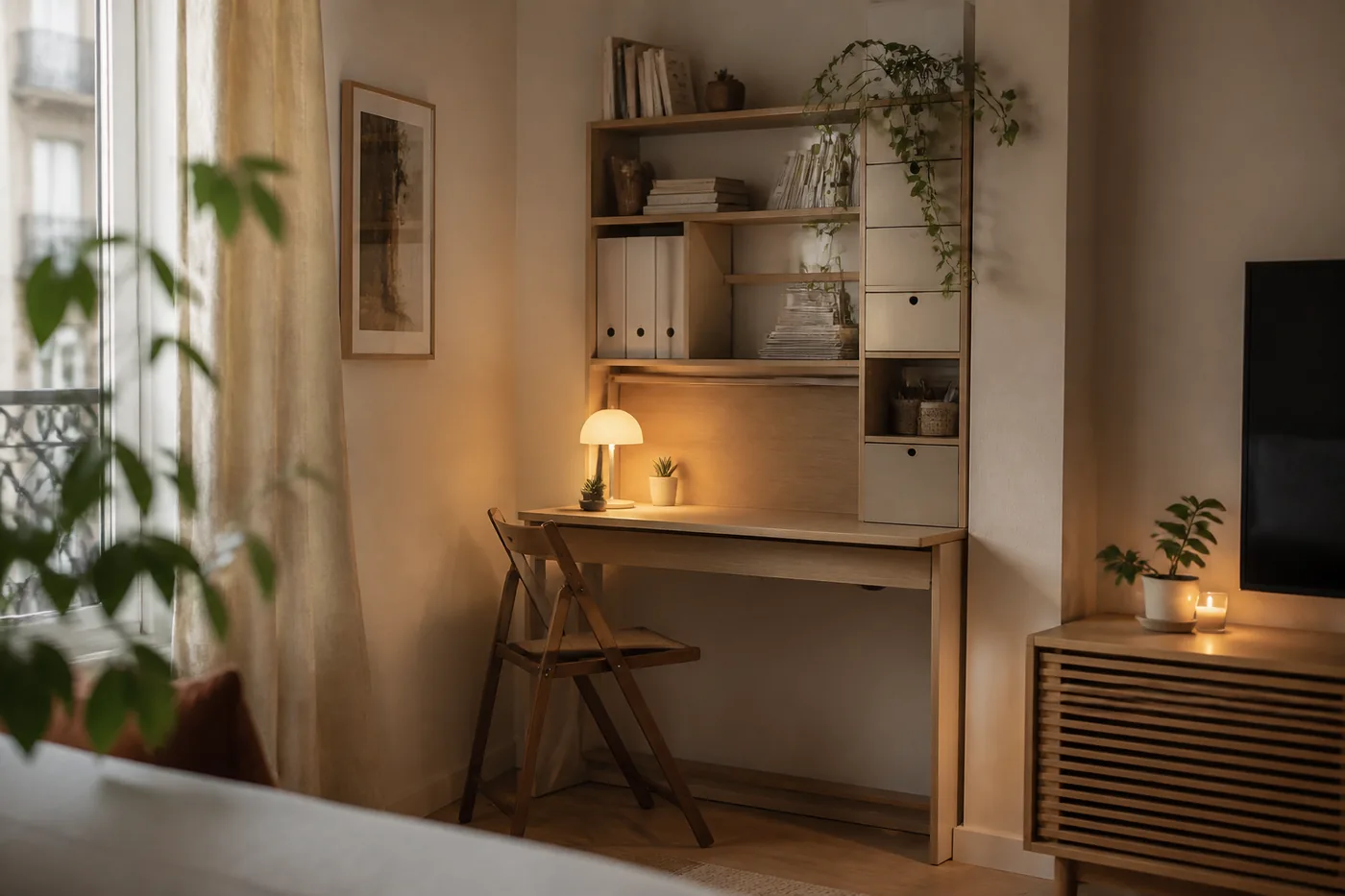
Storage that frees a 31.5–39.4 in (80–100 cm) desk
An 31.5–39.4 in (80–100 cm) desk fails when the top becomes a shelf. Pens, a second notebook, a dock, a charging brick, and a deep caddy can erase the only writing strip you have.
Offload ladder (vertical first): (1) wall / tall freestanding vertical → (2) under-desk trays → (3) side cart or narrow tower → (4) surface tray last. Climb the ladder in that order; do not start with another desktop caddy.
This page is criteria, not a ranked shopping list. Categories and fit rules only — no brand names, no SKUs. Pair it with the desk size guide when the wall itself is the constraint.
The real problem is not “more bins”
Small-desk clutter has three piles:
- Daily tools — pen, notebook, headphones, phone cable.
- Always-on gear — laptop charger brick, hub, monitor power, lamp base.
- Someday stuff — spare cables, old notebooks, product boxes, unused adapters.
Someday stuff does not belong on a 31.5 in (80 cm) top. Always-on gear belongs under or behind the rear edge. Daily tools get one small home you can clear in thirty seconds.
Sort into a “leave the room” box for ten minutes before you measure for a drawer. Otherwise you will own prettier clutter.
Measure clear width between the legs
Under-desk storage fails more often from leg span than from product height.
With the desk empty, measure:
- Clear width between the inner faces of the legs at tray height — usually 4–10 in (10–25 cm) below the underside. A tray sold as “80 cm” may still hit legs that sit 27.6 in (70 cm) apart inside.
- Clear depth from the rear apron to the front underside, minus any crossbar. Many compact desks only have 13.8–17.7 in (35–45 cm) of usable under-desk depth.
- Knee zone. Sit down. Anything deeper than about 12–13.8 in (30–35 cm) under the front half often fights your legs.
- Floor gap. Pedestals and rolling carts need height plus caster clearance.
| Spot | What to capture | Why it matters |
|---|---|---|
| Between legs | Clear inner width | Over-wide trays will not seat |
| Under rear edge | Depth behind knees | Bricks and strips live here |
| Desktop depth | Often 15.7–19.7 in (40–50 cm) | Deep caddies steal writing space |
| Wall above desk | Height to a safe shelf band | Vertical storage needs clearance |
If clear width between legs is under about 21.7 in (55 cm), prefer a narrow tower beside the desk over a centered under-desk drawer.
Vertical first — wall and tall furniture
Vertical storage returns the desktop without inventing floor footprints in the knee zone.
Wall shelves and rails (when allowed)
A single shelf 15.7–23.6 in (40–60 cm) above the desk, spanning most of the width, holds books, a small plant, and closed boxes you touch weekly — not daily grab items that force constant reach on calls.
Keep it shallow: about 7.9–9.8 in (20–25 cm) deep so you do not hit your head when you stand, and so it does not shade a task lamp. Leave the center band above the monitor open; load the sides.
Peg rails work for headphones and light tools only — check rated load and wall type.
Tall furniture beside the desk
When you cannot drill, a freestanding narrow tower 30–40 cm wide (12–16 in) beside the desk is the renter’s vertical move. Match depth to the desk or slightly less so it stays out of the walk lane.
Top third: closed boxes (someday cables). Middle: notebooks and paper. Bottom: a printer only if you need it weekly — printers are floor citizens on a 31.5 in (80 cm) top.
An open shelf behind the desk can also act as a living-room boundary — soft boundaries for living-room desks.
What vertical storage should hold
Closed cable boxes, weekly reference books, a headphone hook, backup notebooks. Not the water you sip every minute, the pen you use every line, or the phone you unlock for 2FA — those stay in a palm zone or create a reach dance.
Desktop organizers that earn their cm
On a 15.7–19.7 in (40–50 cm) deep top, every organizer must buy more calm than it costs in depth.
Worth considering:
- A low tray about 15–20 cm wide × 10–15 cm deep (6–8 in × 4–6 in) for pen, clips, and bud case.
- A slim vertical stand for one active notebook — footprint often under 4 × 9.8 in (10 × 25 cm).
- A monitor stand with one open shelf only if it replaces the monitor’s existing base. If you use an arm, skip it — monitor arms on a narrow desk.
Park organizers at a rear corner, not in the writing strip. Leave a clear rectangle about 16 in wide × 9.8 in deep (40 × 25 cm) for keyboard and notebook — more if you write by hand a lot.
When to skip. Skip anything taller than about 6–8 in (15–20 cm) in your primary sight line. Skip multi-tier “command centers” that claim 9.8 in (25 cm) of depth. Skip a second cup when one already works. Task-lamp bases also consume depth — prefer clamps when the rear edge allows; see desk lamp criteria for tiny desks.
Under-desk drawers and trays — depth limits
Under-desk storage is for bricks, a strip, and quiet paper — not a second desktop in the dark.
Clamp or hang trays along the rear underside: about 30–40 cm wide (12–16 in) on an 80 cm desk, or 16–24 in (40–60 cm) on a 100 cm desk, so legs stay clear. Tray body depth around 4–6 in (10–15 cm) holds a strip and two bricks without burying cables.
Shallow drawers under the top: keep the box under about 12 in (30 cm) front-to-back near your knees. A full-depth drawer under a 19.7 in (50 cm) top often becomes a thigh stopper.
Rolling pedestals: a 40 cm wide (15.7 in) unit needs a matching gap beside a leg. Prefer fully beside the desk; sliding under the center of an 80 cm desk usually fails the knee test.
Storage without cable routing just relocates the tangle — cable management for 80–100 cm desks.
What to skip on a shallow 40 cm top
On about 15.7 in (40 cm) depth (and be skeptical at 50 cm / 19.7 in), skip:
- A desktop UPS or large battery brick on the surface. Park backup power on the floor beside a leg or on a low shelf — follow ventilation rules and printed strip limits. Household layout talk, not electrical-code advice.
- Deep desktop caddies deeper than about 6 in (15 cm) in front of the keyboard line.
- Printer + scanner + paper ream on the top.
- Dual stands plus a giant blotter fighting for the same rectangle — see one-monitor setups.
- Sealed under-desk boxes that bury power bricks. Bricks need air.
- Adhesive hooks on the finished top face of a rental desk.
Treat the front 9.8 in (25 cm) as sacred and the rear 5.9 in (15 cm) as utility.
Renter-safe mounts
Assume no-drill on walls until you have written permission.
Usually removable: clamp trays and clips on a desk you may clamp; hook-and-loop or removable adhesive on the underside of a solid top (test a patch); freestanding towers and screens.
Ask first: screwed wall shelves, pegboards, heavier wall rails.
Skip: screws into honeycomb or hollow-core tops; glass-top clamps for trays; permanent construction adhesive as “storage planning.”
Photograph mounts before move-out.
When vertical-first still fails
Vertical storage fails when the desk is doing three rooms of work. If the tower and the shelf are full and the writing strip is still gone, you do not need another caddy — you need a leave-the-room pass.
Concrete moves.
- Box “someday” cables and put the box in a closet for two weeks. If you never open it, donate or recycle the contents.
- Move the printer to a cart that lives near the router, not under your wrists.
- If paper arrives daily, add a single vertical inbox on the side tower and empty it twice a week — do not grow a paper dune on the 15.7 in (40 cm) top.
When to skip more storage entirely. Skip buying anything new if you have not measured clear width between the legs. Skip a second wall shelf when the first is already a visual wall of stuff — calm layout wants air. Skip under-desk drawers that force a wide knee splay on every sit; comfort preference matters more than a hidden notebook.
A simple keep / park / leave rule
- Keep (desktop palm zone): one shallow tray, active notebook, laptop, phone-cable slack.
- Park (vertical or under-rear): chargers, hub, spare notebook, headphones on a hook, closed cable box.
- Leave (another room): packaging, unused adapters, archival paper, the printer you touch monthly.
Re-run the sort when the writing strip disappears. For light, pair a freed desk with desk lamp criteria. For wall width, return to the size guide.
Related guides
- Desk size guide
- Cable management on an 80–100 cm desk
- Desk lamp criteria for tiny desks
- Soft boundaries for a living-room desk
- One-monitor setups that look intentional
- Monitor arms on a narrow desk
Disclaimer
This guide is layout and storage criteria for small desks. Typical measurements vary — measure your own desk, follow printed load and ventilation limits, and check your lease before drilling.
What to look for (named examples)
Criteria first, then our constraint scores. Public-spec examples so you can search a real listing — not Amazon stars, and not a claim that we sat in a lab with a dozen desks.
Disclosure. Outgoing links go to the maker’s search or a generic retailer search until a partner tag is connected. After that, some links may be affiliate links — we may earn a commission if you buy, at no extra cost to you. Rankings on this site are our constraint scores (depth, leftover width, clamp, renter risk, cable drop). They are not Amazon stars or scraped reviews. We do not invent first-person lab tests.
IKEA
SKÅDIS pegboard 29.9 × 22 in (76 × 56 cm)
Width 29.9 in (76 cm) · Height 22 in (56 cm)
Our score 3.2 / 5 · depth 5 · width 4 · renter 2
- Solves: Vertical offload so trays leave the 31.5–39.4 in (80–100 cm) writing strip.
- Fits: A wall you may mark, or a freestanding/stand-off mount that does not drill. Above an 31.5–39.4 in (80–100 cm) desk.
- Skip if: Lease forbids wall marks and you have no freestanding frame — then use a side tower or a caddy instead.
Public IKEA listing: 29.9 × 22 in (76 × 56 cm) board. This is storage criteria, not a claim that pegboards are no-drill.
Check the current listing · search “IKEA SKÅDIS 76x56”
IKEA
SIGNUM cable tray
Width 27.6 in (70 cm)
Our score 3.4 / 5 · depth 4 · width 4 · renter 2
- Solves: Gets the strip and brick off the writing surface and the walk path.
- Fits: Underside screws into a top you own (or already have permission to mark). About 27.6 in (70 cm) tray on an 31.5–39.4 in (80–100 cm) desk.
- Skip if: A rental top you must return unmarked and have no clamp tray as a substitute.
Public IKEA listing: SIGNUM cable tray, commonly ~27.6 in (70 cm). Measure underside screw line before you buy.
Check the current listing · search “IKEA SIGNUM cable tray”
Find what fits my space
When the wall is 31–47 in (80–120 cm) and the lease matters.