Updated 2026-09-01
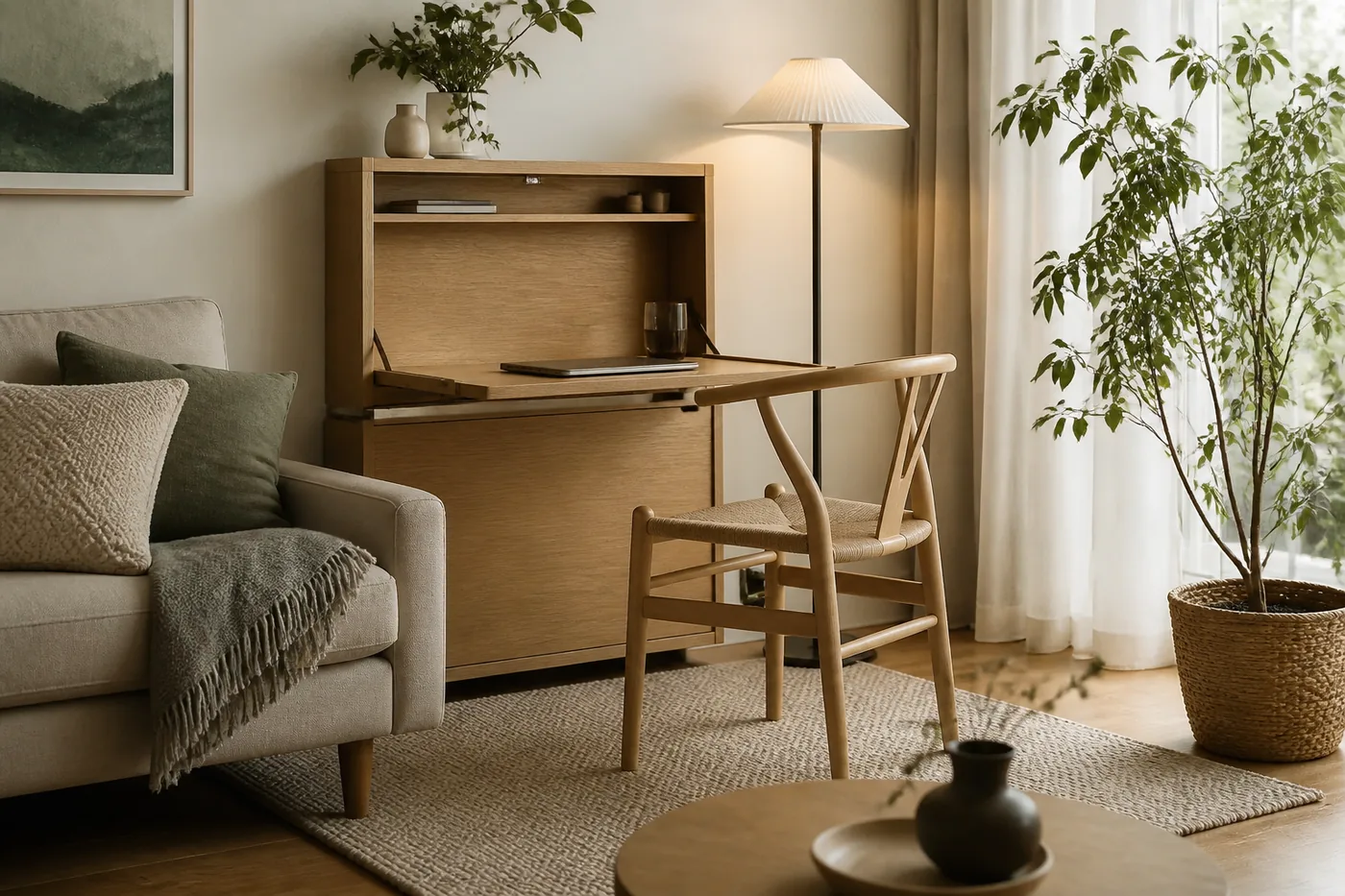
Soft boundaries for a living-room desk (rugs, screens, fold-away)
You do not need a spare room to give work an edge. In a living room, the job is not “build an office.” It is to mark a small zone so guests, partners, and your evening self can tell when the laptop is on and when it is gone.
Soft boundaries do that with furniture and fabric you can move: a rug under the chair, a screen or open shelf behind the desk, a fold-away top when the lease allows, and a shutdown habit that hides the surface. This is calm layout — clearer walk paths, less visual noise, a room that can host dinner after a call.
Why a living-room desk needs a soft boundary
A living room already has jobs: sit, eat, watch, pass through. A desk that looks permanent can make the whole room feel like leftover office. A desk that disappears into the sofa mess can make every evening feel like you never left the inbox.
A soft boundary solves both. It does not need a door. It needs a readable edge: something under your feet, something behind your screen, or a top that folds flat so the lounge returns.
Pick one primary boundary and one backup. Three systems at once on a 31.5–39.4 in (80–100 cm) wall usually look busier than the tangle you started with.
Measure the zone before you decorate
Tape the floor for a week before you buy a rug or a screen.
- Desk footprint. Typical compact tops land around 80–120 cm wide × 40–60 cm deep (31.5–47.2 in × 15.7–23.6 in). Confirm the wall with the desk size guide.
- Chair rollback. From the front edge, leave about 35–43 in (90–110 cm) for a rolling task chair. Living rooms often need an extra walk lane of about 24 in (60 cm) so someone can pass.
- Sight line. Sit where the chair will be. Note the door, TV, sofa backs, and window glare. A calm layout usually prefers seeing the room entrance if the wall allows, and a solid feel behind you (wall, shelf, or screen) rather than floating with your back fully exposed to traffic.
- Power. Find the nearest outlet. Plan a baseboard run, not a diagonal across the sofa path — cable management for 80–100 cm desks.
Write the numbers on a sticky note. Decor comes after the tape.
The rug as a zone marker
A rug is the cheapest readable edge in an open plan. It tells your feet — and everyone else’s eyes — where work starts.
Size. The rug should hold the chair’s rear casters when you sit and when you roll back about 12–16 in (30–40 cm). For many 31.5–39.4 in (80–100 cm) desks, that means about 120–160 cm deep × 140–180 cm wide (47–63 in × 55–71 in), not a tiny mat that only hugs the desk feet.
Placement. Align the front of the rug with the front of the desk, or let the desk sit fully on the rug with 4–8 in (10–20 cm) of fabric showing in front. Skip a step-up lip where you stand to leave a call.
Texture. Choose something that survives casters and vacuuming. Echo sofa tones rather than a loud “office” pattern. Soft pile traps crumbs under a rolling chair — flatter weaves usually last better.
When to skip. Skip a rug on thick carpet (double soft surfaces make rolling miserable). Skip oversized rugs that cover the only walk lane to the balcony. The rug marks the floor; it does not store cables or hold a monitor. Pair it with one vertical boundary if the desk still reads as lost furniture.
A folding screen or open-shelf back
When the desk sits with its back to the sofa or TV, add a vertical edge so the room does not stare at your screen glow — and so traffic does not walk through your calls.
Folding screen
A freestanding folding screen (often three panels) creates a temporary wall without screws. Typical heights land around 59–71 in (150–180 cm) — tall enough to hide a seated screen from the sofa.
Concrete moves.
- Park the screen behind the chair if your back faces the room, or beside the desk to hide cable mess from the entry.
- Leave a 24 in (60 cm) pass gap at one end so the screen is a boundary, not a trap.
- Angle one panel toward the entrance so you keep a partial sight line.
- At shutdown, fold it flat against a wall or into a closet if floors allow easy movement.
When to skip. Skip it in a narrow living room where the only path is already under 31.5 in (80 cm) — a screen becomes a hallway blocker. Skip lightweight paper screens if pets or kids will tip them. Never block a radiator or fire-exit path.
Open shelf as a soft back
An open bookcase or low open shelf behind the desk (or as a sofa console facing the desk) gives a solid feel without a solid wall. Aim for about 80–120 cm wide (31.5–47.2 in) to match the desk, and about 70–100 cm tall (27.6–39.4 in) if you still want daylight over the top.
Face the finished back toward the living room when the unit has one. Baskets on the lounge side for remotes; work bins on the desk side. That split is the boundary.
When to skip. Skip a tippy tall unit freestanding in a kid-heavy home unless you can secure it (securing often means drilling). Skip stuffing the shelf until it equals the desk clutter.
Fold-away and wall desks when the lease allows
If the living room must fully return to lounge mode most evenings, a fold-away or wall-mounted desk is the strongest soft boundary: the surface itself leaves.
Typical open footprints sit around 60–80 cm wide × 40–60 cm deep (24–31.5 in × 15.7–23.6 in). Closed depth often drops to about 3.9–7.9 in (10–20 cm) — check the hinge. Compare types in folding vs corner vs sit-stand for renters.
Concrete moves when drilling is allowed.
- Confirm wall type and get written permission if the contract is silent.
- Use the fold-away for laptop + lamp, not a heavy monitor on a clamp arm — thin folding tops are poor arm hosts.
- Keep a closed box or cart nearby for keyboard, notebook, and chargers so folding is a two-minute job.
- Route power along the baseboard so nothing hangs when the top is up.
When to skip. Skip if you cannot drill and the only options are tension or adhesive mounts that will not hold daily typing. Skip if work needs a persistent dual-monitor wall — wrong tool. Skip sit-stand here if soft laminate cannot take the feet and you change height many times a day.
No-drill alternatives: a console that clears to a tray at night, a freestanding drop-lid piece, or a dining-table end with a closable caddy. Less vanishing than a wall fold; kinder to the lease.
A shutdown that hides work
Boundaries fail if the surface still looks like Monday at 9 p.m. Build a five-minute shutdown before dinner.
- Close the laptop, or park / fold the screen.
- Kill the task light; leave the living-room lamp on if people are still around.
- Clear the front 12 in (30 cm): notebook into a box, pens into a cup on the shelf, mug to the kitchen.
- Clip or tray any cable that drapes toward the sofa — cable guide.
- Fold or angle the screen if you use one; straighten the rug so the zone still looks intentional.
If shutdown takes more than five minutes, you own too much on the top. Move to vertical storage next.
Renter constraints (no-drill first)
Assume no-drill until the lease or landlord says otherwise in writing. This is household caution for apartment rentals, not legal advice — your contract wins.
Landlord / lease risk ranking (start at the top)
Rank tools by how much they touch the building, then by how long a nightly reset actually takes:
- Rug (lowest landlord risk). No wall contact. Nightly reset: straighten edges, tuck chair — often under 1 minute. Start here when the lease is silent or strict.
- Freestanding screen or open shelf (low risk). No screws if the unit stands alone. Nightly reset: fold or angle the screen / face baskets lounge-side — often 1–3 minutes. Skip if the only walk lane is already under about 31.5 in (80 cm).
- Freestanding fold / drop-leaf / clearable console (low–medium). Still no wall holes. Nightly reset must be honest: if closing takes more than about five minutes, you will abandon it.
- Wall-mounted fold-away or wall rails (highest risk). Needs written permission when the lease is silent. Open vs closed depth often about 40–60 cm open and 10–20 cm closed — confirm the hinge. Only choose this when you will fold most evenings and the landlord allows the fixings.
Usually fine without holes: rugs; freestanding screens; freestanding open shelves and consoles; clamp trays on a desk you own; hook-and-loop under a desk you own; removable adhesive clips for light cables (test paint); furniture-as-wall (desk in front of a bookcase).
Ask first: wall-mounted fold-away desks; wall rails and pegboards; wall-mounted monitor arms; any screw into shared walls.
Move-out. Photograph before and after. Soft boundaries should leave soft evidence.
When open-plan fails — and when to skip
Soft boundaries fail when:
- The walk lane is the desk lane. If every kitchen trip crosses your keyboard, a rug will not save focus. Move to a dead corner or another room — small-apartment work corners and a calmer desk corner.
- Glare and TV fight the same wall. Turn the desk ninety degrees, or keep that wall laptop-only.
- Noise has nowhere to go. Soft boundaries hide visuals; they do not soundproof. Shared living rooms need headphones and housemate norms, not more fabric.
- “Temporary” gear keeps stacking. A second monitor, a desktop UPS, and a printer on the sofa console means the soft boundary already lost.
- The only “fix” needs drill rights you do not have. If a wall fold is the only way the room returns to lounge and the lease forbids fixings, do not improvise with weak adhesive mounts — switch to freestanding fold/clearable console or accept a different wall.
Skip soft-boundary theatrics when you already have a door you can close — use the door. Skip buying a screen, a rug, and a fold-away in one weekend; start with the lowest landlord-risk tool that still gives a readable edge, live a week, then add. Never block a radiator, balcony door, or fire escape in the name of “zone.”
Related guides
- Folding vs corner vs sit-stand for renters
- A calmer desk corner
- Small-apartment work corners
- Cable management on an 80–100 cm desk
- Desk size guide
- Storage that frees an 80–100 cm desk
Note
Typical sizes vary — measure your own space and read your lease.
Quick answers
What counts as a soft boundary for a living-room desk?
A moveable edge guests can read: a rug that stops under the chair, a screen or open shelf behind the desk, or a fold-away top — plus a shutdown that hides the laptop.
When does an open-plan living room fail as an office?
When dinner, TV, or the walk path still cut through the chair zone after you mark the rug. Soft boundaries cannot invent a spare room.
Find what fits my space
When the wall is 31–47 in (80–120 cm) and the lease matters.