Updated 2026-09-01
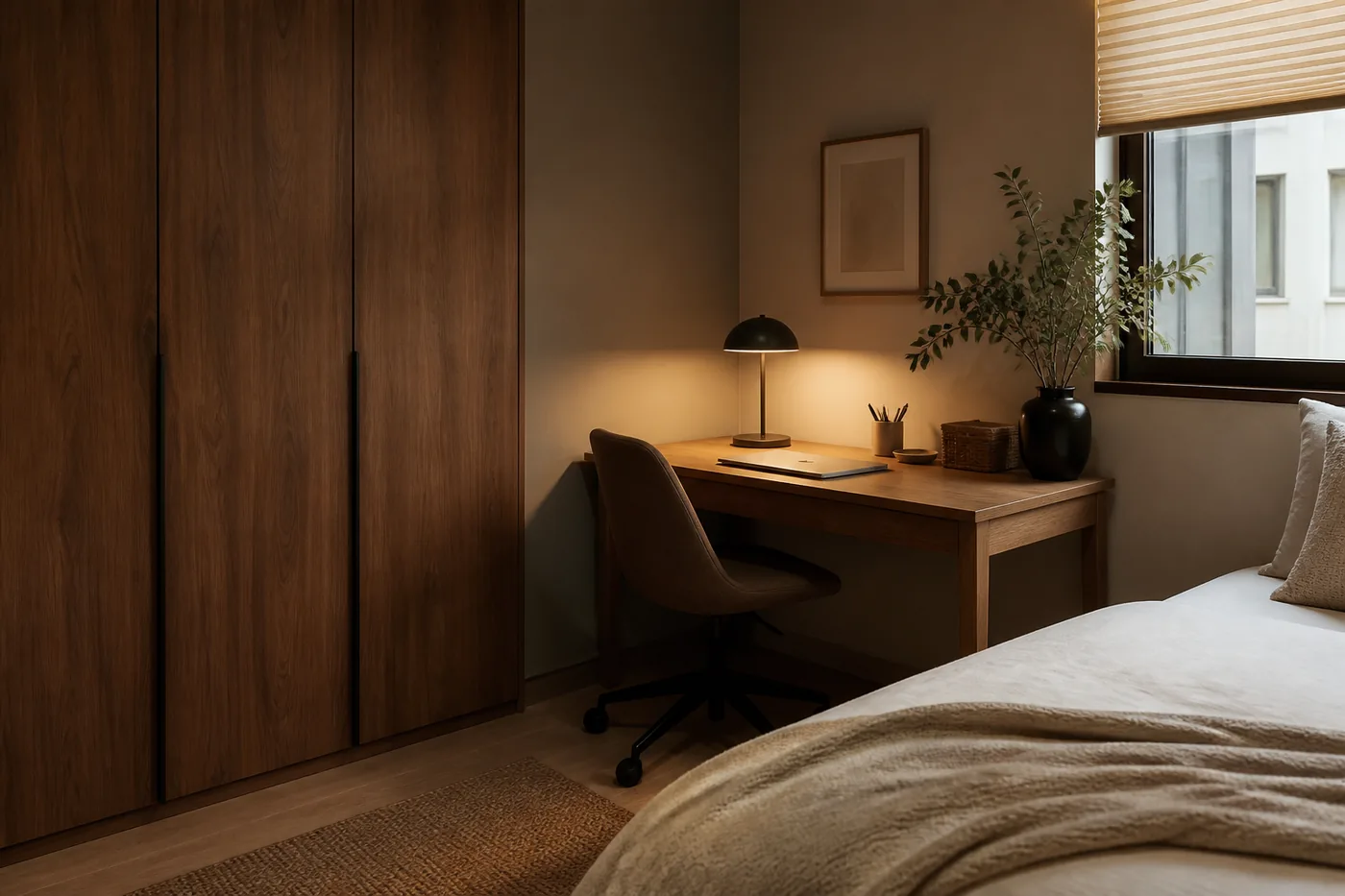
A calmer desk corner — layout habits that cut visual noise
You do not need a new desk to make a small corner feel quieter. You need a few layout habits that cut visual noise: where you sit relative to the door, what sits behind your chair, how much of the top stays empty, how light hits the screen, and how you close the day.
This page is calm layout — clearer sight lines, less clutter in pillow or sofa view, a walk path that still works. If a bedroom corner is fighting sleep, pair this with the bedroom guide. If the living room needs a readable zone, use soft boundaries. Here we stay with habits you can try in a week without buying a fortress of gear.
What “calmer” means here (and what it does not)
On a 31.5–39.4 in (80–100 cm) desk in a shared apartment, “calmer” usually means five practical outcomes:
- You can see who enters when the room allows it — awareness, not a sealed booth.
- Your back is not floating in open traffic; something solid or semi-solid sits behind the chair.
- The front third of the top stays clear most of the day so wrists and notebooks have room.
- Light comes from the side more often than from a bright bounce off the screen.
- Evening still looks like evening — work light and open laptop do not run until bedtime by default.
What “calmer” does not mean on this site: curing stress as a medical claim, attracting luck, prescribing crystals, or ranking products we “tested.” We write criteria and habits. Measure your own wall; your lease and your eyes win.
Sight line to the entrance if the room allows
Sit in the chair you already have. Without turning fully, can you notice the door or room entrance?
If yes, keep that. A calm corner often prefers a partial sight line so you are not startled on a call. Angle the desk a few degrees toward the door if a full face-to-door layout wastes your only window.
If the only free wall puts your back fully to the door and you cannot rotate, compensate with a solid feel behind you and a soft boundary — a shelf, a screen edge, or a tall plant. Do not block the door swing or a fire path to win a sight line.
Concrete move. Tape the desk footprint. Sit for five minutes. Note door, glare, TV, bed. Prefer soft view of the entrance and a screen out of pillow or sofa glare. If you must choose one, protect sleep and guest comfort first.
A solid feel behind the chair
A chair floating in the middle of a studio with open space behind your shoulders often feels busier than the same chair against a wall — even when the top is identical. Put something trustworthy behind you.
Good solid feels (pick one): a real wall; a low open shelf or bookcase about 27.6–39.4 in (70–100 cm) tall behind or beside the chair, finished face toward the room; a freestanding screen with a 24 in (60 cm) pass gap at one end — detail in soft boundaries for a living-room desk; or a wardrobe side if that is the only leftover strip.
Skip. Tippy boxes stacked “for height.” A tall empty rack stuffed with cables in guest view. Anything that makes chair rollback hit a hard edge every time you stand — leave roughly 35–43 in (90–110 cm) for a rolling chair where the room allows, or use a tuck-under stool in a hall niche.
Solid feel is backing, not a cave. Keep daylight if you have it. A calm corner still needs a walk path.
Map what stays in view (sit-test)
Sit where you already work for two minutes. Without turning your head more than a little, name everything that stays in view for a full call or deep-work block. That cone is what stays in view while you work.
Allowed in that field during work blocks: laptop or one screen, keyboard/notebook strip, one task lamp, at most one small calm object (a plant or a cup).
Parked outside the cone: spare chargers, mail piles, laundry, kitchen spillover, vertical files, second empty trays. Put them on a shelf behind you, in a drawer, under the rear edge, or on the other side of a soft boundary.
Sit-test habit (weekly). Re-sit after you add anything new. If the new object sits in the cone and does not earn a job, move it before the next work block. Prefer quieter sightlines over a “perfect” empty room.
If the pillow or the sofa arm shares the same cone, you will feel “always at work”; fix the cone before you buy more decor.
Clear the surface — depth you can actually use
Visual noise loves a shallow top. On a 15.7–19.7 in (40–50 cm) deep desk, a monitor, a laptop, a mug, a dock, and a notebook fight for the same strip. The calm habit is not “own nothing.” It is keep the front 10–12 in (25–30 cm) mostly clear during work, and clear more at shutdown.
Park the monitor or laptop stand toward the rear edge. One cup for pens — not three trays. Dock and bricks belong in a short under-desk tray or mounted strip — see cable management on an 80–100 cm desk. Paper that survives the day goes vertical, not into a spreading stack in pillow view.
Skip five desktop organizers on a 31.5 in (80 cm) width; they become the clutter. If you are still choosing the desk, confirm usable depth before inventing habits for a top that never had margin.
Side light versus glare on a shallow top
Glare is visual noise you feel before you name it. On a shallow apartment desk, a bright window straight behind the screen, or a lamp bounced into glossy laminate, will make the corner feel tense even when the cables are tidy.
Prefer side light. Place the main task lamp to the left or right of the keyboard so the beam washes the work surface, not the panel. If daylight is strong, sit so the window is beside you rather than directly in front of or behind the screen when the room allows. Rotate the desk ninety degrees before you buy anti-glare film.
After hours. Warm task light aimed at the keys beats a cool ceiling flood that turns the corner into a late office. Kill the desk lamp at shutdown even if the room lamp stays on for living.
Bedroom note. If the desk shares a sleeping wall, never leave a bright cool key light aimed toward the pillow. Park or cover the screen; use bedroom desk without wrecking sleep for orientation and night habits. Lamp categories (clamp vs base, beam vs flood) belong on the lamp criteria page — this section is only placement relative to glare.
Soft boundaries for work / sleep or work / living
Calm layout fails when the same rectangle is forever “office” in a room that also has to be bed or lounge. You do not need a spare room. You need a readable edge.
Work / sleep. Point the screen away from the pillow. Prefer a top you can clear or a chair that tucks fully under. Warm light only after hours; same power strip for monitor and cool video light so one click ends both. Detail: bedroom desk without wrecking sleep.
Work / living. Use a rug under chair casters, a screen or open shelf behind the desk, or a fold-away top when the lease allows. Guests should be able to tell when work is open. Detail: soft boundaries for a living-room desk and scene ideas in small-apartment work corners.
Pick one primary boundary. A rug plus a screen plus three desktop caddies on a 39.4 in (100 cm) wall usually looks louder than the mess you meant to fix.
A five-minute end-of-day shutdown
Habits beat furniture when the day ends. Build a shutdown you can finish before dinner.
- Close the laptop or turn the screen toward the wall / fold the top.
- Kill the task light. Leave living-room light if people are still home; end desk light, not the whole apartment.
- Clear the front 12 in (30 cm): notebook into a drawer or closed box, mug to the kitchen, spare cables coiled once.
- One cable check: nothing draping into the walk path or across the bed edge — cable guide.
- Chair fully under so the corner reads as furniture, not an open ticket queue.
If shutdown takes longer than five minutes, you own too much on the top. Remove one category this week — extra chargers, decorative objects that do not earn space, a second empty cup. Shutdown is a layout habit, not a productivity religion.
When to skip rearranging
Skip a full calm-corner project when:
- The real problem is size. Usable depth under about 15.7 in (40 cm) after sill and radiator gap will fight every habit — measure first, or pick a different wall.
- You need a door more than a sight line. If deep work requires quiet and the living room is the family hub from late afternoon, furniture will not invent privacy. Schedule, headphones, and norms with housemates matter more than angling the desk.
- You are buying three systems at once. One habit per few days beats a weekend of new shelves, rugs, and lamps that arrive as new clutter.
- Lease or safety forbids the move. No screen across a radiator, no shelf blocking an exit, no drilling without permission.
Calm layout is optional kindness to your evening self — not a requirement to decorate your way into productivity.
Related guides
- Bedroom desk without wrecking sleep
- Cable management on an 80–100 cm desk
- Small-apartment work corners
- Soft boundaries for a living-room desk
Note
Typical sizes vary by furniture and building; measure your own space and follow your lease.
Quick answers
What does a calmer desk corner actually change?
Sight line to the entrance if the room allows, a solid feel behind the chair, a clear front third of the top, side light, and a five-minute shutdown — not a medical calm claim.
When should I skip rearranging the corner?
When usable depth is under about 15.7 in (40 cm) after sill and radiator, when you need a door more than a sight line, or when the lease forbids the move.
Find what fits my space
When the wall is 31–47 in (80–120 cm) and the lease matters.