Updated 2026-09-02
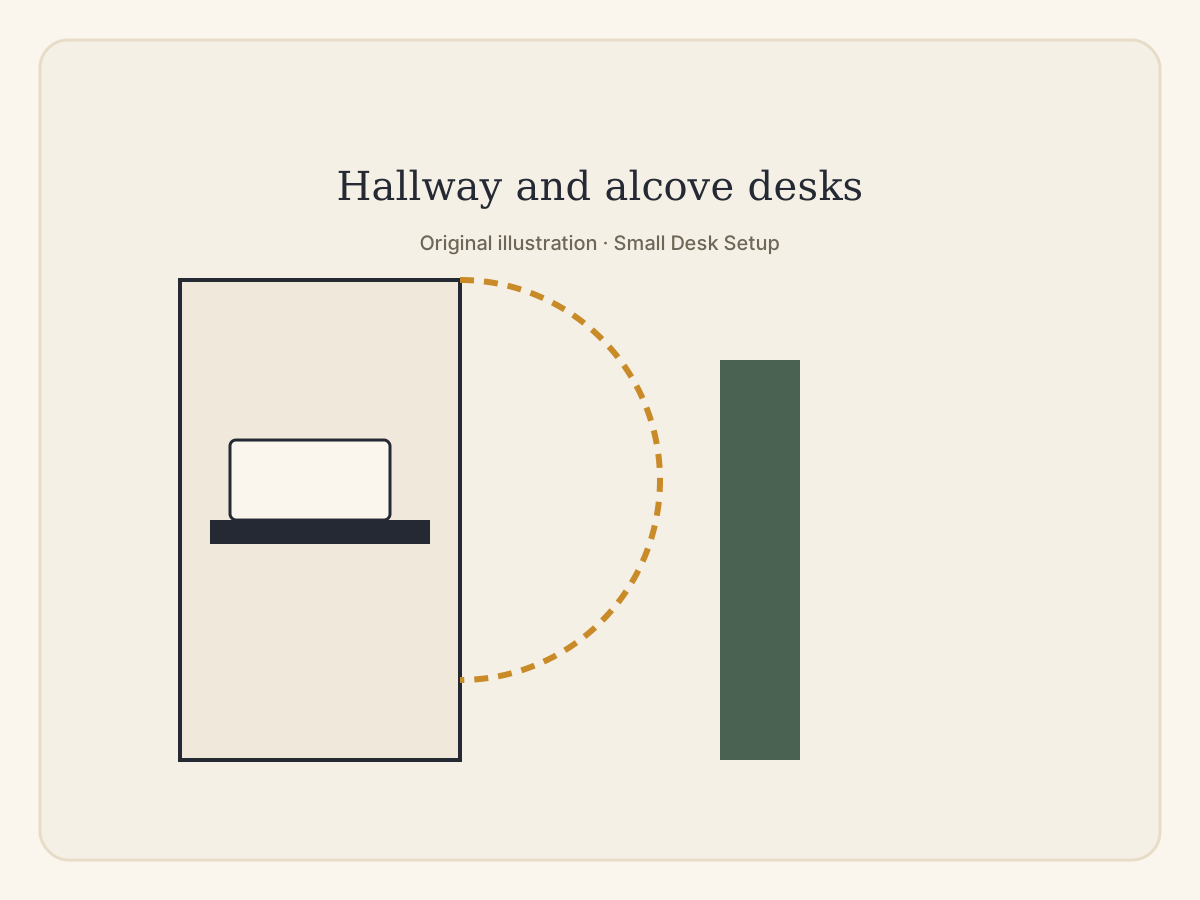
Hallway and alcove desks
Floor plans love leftover niches. Chairs and doors do not. An alcove that looks “free” on paper often fails once you add a seat, a door arc, and a person walking to the bathroom. This page is when a hallway strip is a real work corner, and when it is a coat zone with a laptop fantasy.
Measure first. Link chair rollback clearance and the desk size guide. This is household caution, not invented building-code claims, and not “command position” language.
Measure the niche like a door, not like a desk ad
Tape, in this order:
- Clear width and depth after baseboard, radiators, and the door when it is open and when it is closed.
- Chair rollback without blocking the bathroom, front door, or fridge path. If a second person cannot pass, this is a traffic lane, not an office.
- Screen privacy. Can someone walking past read your call? That is household courtesy, not security theater.
If the niche is narrower than the chair, stop. A 27.6 in (70 cm) slot with a 25.6 in (65 cm) seat is a coat hook.
Three layouts that sometimes work
1. Shallow top, laptop only if depth is ~15.7–17.7 in (40–45 cm). No monitor, no plant jungle, no second tray. See desk depth for laptop plus notebook.
2. Fold-down if the hall is also an exit path that must stay clear at night. The surface closes; the chair tucks or lives elsewhere. Folding types as criteria: folding vs corner vs sit-stand.
3. Skip wall shelves over a door swing. Forehead and lease both lose. Storage belongs beside the niche or on the desk’s own vertical — storage that frees an 80–100 cm desk.
A lamp in a hall should not strobe the bedroom. Clamp to furniture you own; ranking on no-drill hardware.
Noise and “public calls”
Hall desks are public to the apartment. Headphones are courtesy, not a product roundup. If every meeting is audible to the shower queue, this niche is for email and packing, not for six hours of video.
When calls need a door, move to a bedroom desk with a shutdown instead of hanging a felt pad and calling it a studio.
Skip if
- The door arc overlaps the rollback every time someone leaves.
- Clear depth after the radiator is a sill, not a desk.
- You need a sight line to a window that this niche does not have and you already glare-fail on the only other wall — do not stack two bad walls.
- Night traffic means the chair never tucks, so the hall never reads as a hall.
Then keep coats in the niche and put work on a wall that can close.
Limits
Centimeters, doors, and household privacy. Measure the arc with the door in your hand, not from a listing photo.
What to look for (named examples)
Criteria first, then our constraint scores. Public-spec examples so you can search a real listing — not Amazon stars, and not a claim that we sat in a lab with a dozen desks.
Disclosure. Outgoing links go to the maker’s search or a generic retailer search until a partner tag is connected. After that, some links may be affiliate links — we may earn a commission if you buy, at no extra cost to you. Rankings on this site are our constraint scores (depth, leftover width, clamp, renter risk, cable drop). They are not Amazon stars or scraped reviews. We do not invent first-person lab tests.
IKEA
MICKE desk 28.7 × 19.7 in (73 × 50 cm)
Footprint 28.7 × 19.7 in (73 × 50 cm)
Our score 3.8 / 5 · depth 3 · width 5 · renter 5
- Solves: A compact drawer desk that still leaves a writing strip on a short bedroom wall.
- Fits: Wall leftover about 31.5–35.4 in (80–90 cm); laptop-only or laptop plus a slim notebook. One shallow drawer for shutdown.
- Skip if: You need a 27 in monitor on a factory stand — 19.7 in (50 cm) depth plus the stand usually kills the notebook band.
Public IKEA listing: 28.7 × 19.7 in (73 × 50 cm). Treat drawer depth as part of the sit-test, not extra storage fantasy.
Check the current listing · search “IKEA MICKE 73x50”
Find what fits my space
When the wall is 31–47 in (80–120 cm) and the lease matters.