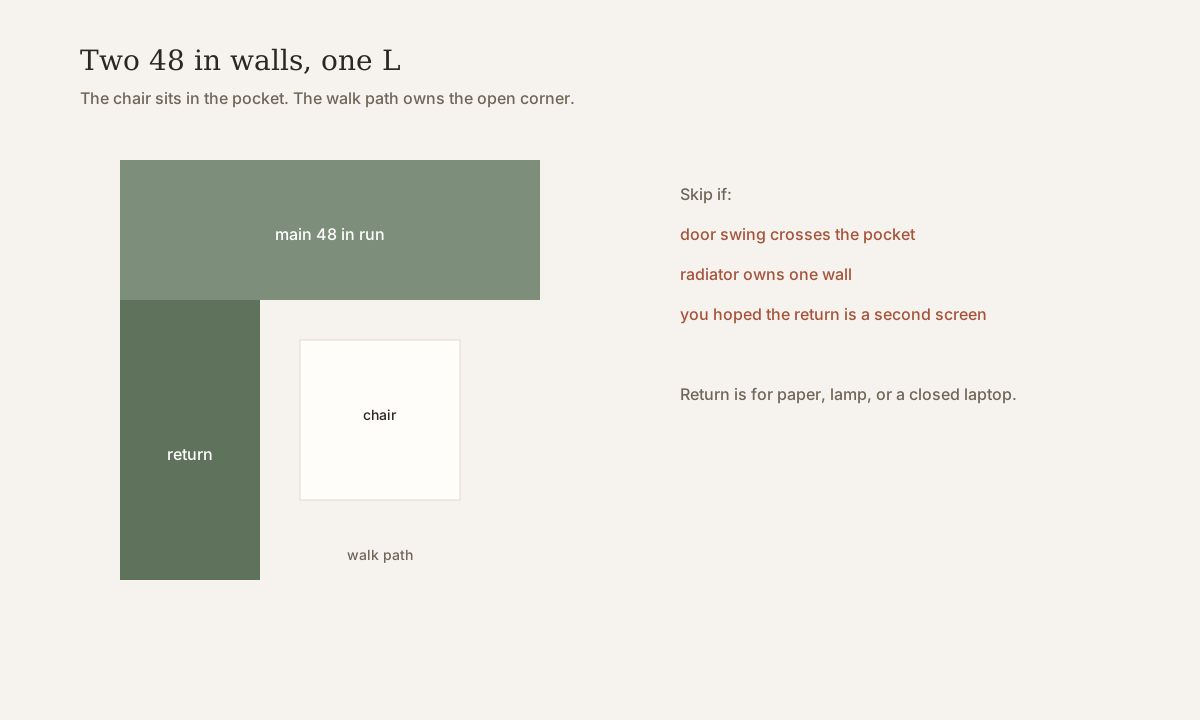
L-shape on two 48 in walls
One leftover wall under 48 in is a shopping problem — small desk under 48 in. Two leftover walls that meet are a layout problem: you can split the work instead of forcing a single 48 in slab into a 48 in hole.
This is not a hallway alcove (width vs door swing on one niche). It is a corner pocket in a studio, living room, or bedroom.
When two short walls beat one long desk
Build an L when all of these are true:
- Wall A is a clear leftover about 44–52 in (112–132 cm)
- Wall B is a clear leftover about 36–48 in (91–122 cm)
- The open corner still has a walk path that is not the only route to the bed or the exit
- You can sit in the pocket without a door arc crossing your knees
If only one wall is clear, use a single footprint — 24 × 48 in corner or a shorter top.
Who owns which run
| Run | Job | Typical top |
|---|---|---|
| Main (longer leftover) | One 24–27 in panel or the laptop | 39.4–47.2 in (100–120 cm) if the leftover allows margin |
| Return (shorter leftover) | Notebook, lamp, closed laptop, mug | 28.7–39.4 in (73–100 cm), shallower if the pocket is tight |
| Chair | 35–43 in (90–110 cm) from the main front edge |
The return is not a second monitor. Dual screens on two short walls still want more glass than you have — desk width vs monitor.
A factory corner wedge often steals the pocket with dead wood. Two straight tops that meet, with a 1–2 in (2–5 cm) gap you can cable through, are usually calmer.
Radiators, windows, doors
Subtract before you buy:
- Radiator on either wall: window-wall allowance. An L that blocks heat is a lease fight.
- Glare on the main run: turn the panel perpendicular to glass — window glare.
- Door swing through the pocket: that wall is not yours. This becomes an alcove problem.
Living-room corners still need a soft edge so dinner does not eat the return — soft boundaries.
Depth and rollback
The main run can be 23.6 in (60 cm) deep if rollback holds. The return should be shallower — 15.7–19.7 in (40–50 cm) — so the chair can rotate without clipping a second thick apron. Sit-test both fronts. Chair rollback is still the number that decides sleep in a bedroom.
Two people on one L is a different page — two-person tiny desk. An L does not automatically become two workplaces.
Renter hardware
Do not assume you may screw a corner bracket into plaster. Clamp lamps and one arm on the main top; keep the return clamp-free if the lip is already crowded — clamp-only upgrades. Shape choice (folding vs sit-stand vs corner) stays on folding vs corner vs sit-stand.
Named writing slabs (LAGKAPTEN 39.4 or 47.2 in class, MICKE as a short return) are public listing sizes. Confirm the live spec. Scores are ours, not Amazon stars.
Skip if
- One of the two “walls” is a radiator you must not cover.
- The pocket is the only path to the exit.
- You wanted the return to hold a 32 in panel.
- Either leftover is under ~36 in and you will not go laptop-only on that run.
Two short walls. One chair. Measure the pocket twice.
Quick answers
Can I make an L-desk with two 48-inch leftover walls?
Yes if both walls are clear, the chair pocket is not a door swing, and the return is for paper or a closed laptop — not a second monitor. Each run still needs side margin, so a 48 in top on a 48 in leftover is usually too tight.
Is an L better than one 24 × 48 in desk?
An L wins when you have two short leftovers and one chair pocket. A single 24 × 48 in footprint wins when only one wall is clear. Do not build an L on a hallway door.
Do I need a factory corner desk?
No. Two straight tops that meet, or one top plus a shallow return you already own, are enough. Factory corner units often waste the pocket with a thick wedge.
What to look for (named examples)
Criteria first, then our constraint scores. Public-spec examples so you can search a real listing — not Amazon stars, and not a claim that we sat in a lab with a dozen desks.
Disclosure. Outgoing links go to the maker’s search or a generic retailer search until a partner tag is connected. After that, some links may be affiliate links — we may earn a commission if you buy, at no extra cost to you. Rankings on this site are our constraint scores (depth, leftover width, clamp, renter risk, cable drop). They are not Amazon stars or scraped reviews. We do not invent first-person lab tests.
IKEA
LAGKAPTEN tabletop 39.4 × 23.6 in (100 × 60 cm)
Footprint 39.4 × 23.6 in (100 × 60 cm)
Our score 3.6 / 5 · depth 4 · width 3 · renter 4
- Solves: A 39.4 in (100 cm) writing strip with 23.6 in (60 cm) depth for one laptop plus a notebook or one monitor.
- Fits: Clear wall about 43.3 in (110 cm)+ after door swing and radiator margin; rollback still ≥ 35.4 in (90 cm).
- Skip if: Leftover wall under 39.4 in (100 cm), or chair zone under ~35.4 in (90 cm) — 23.6 in (60 cm) depth will eat the bed path.
Public IKEA listing: 39.4 × 23.6 in (100 × 60 cm) top, about 0.7 in (18 mm) thick. Pair with legs or a trestle you already own.
Check the current listing · search “IKEA LAGKAPTEN 100x60”
IKEA
MICKE desk 28.7 × 19.7 in (73 × 50 cm)
Footprint 28.7 × 19.7 in (73 × 50 cm)
Our score 3.8 / 5 · depth 3 · width 5 · renter 5
- Solves: A compact drawer desk that still leaves a writing strip on a short bedroom wall.
- Fits: Wall leftover about 31.5–35.4 in (80–90 cm); laptop-only or laptop plus a slim notebook. One shallow drawer for shutdown.
- Skip if: You need a 27 in monitor on a factory stand — 19.7 in (50 cm) depth plus the stand usually kills the notebook band.
Public IKEA listing: 28.7 × 19.7 in (73 × 50 cm). Treat drawer depth as part of the sit-test, not extra storage fantasy.
Check the current listing · search “IKEA MICKE 73x50”